LYS Polychem Blog
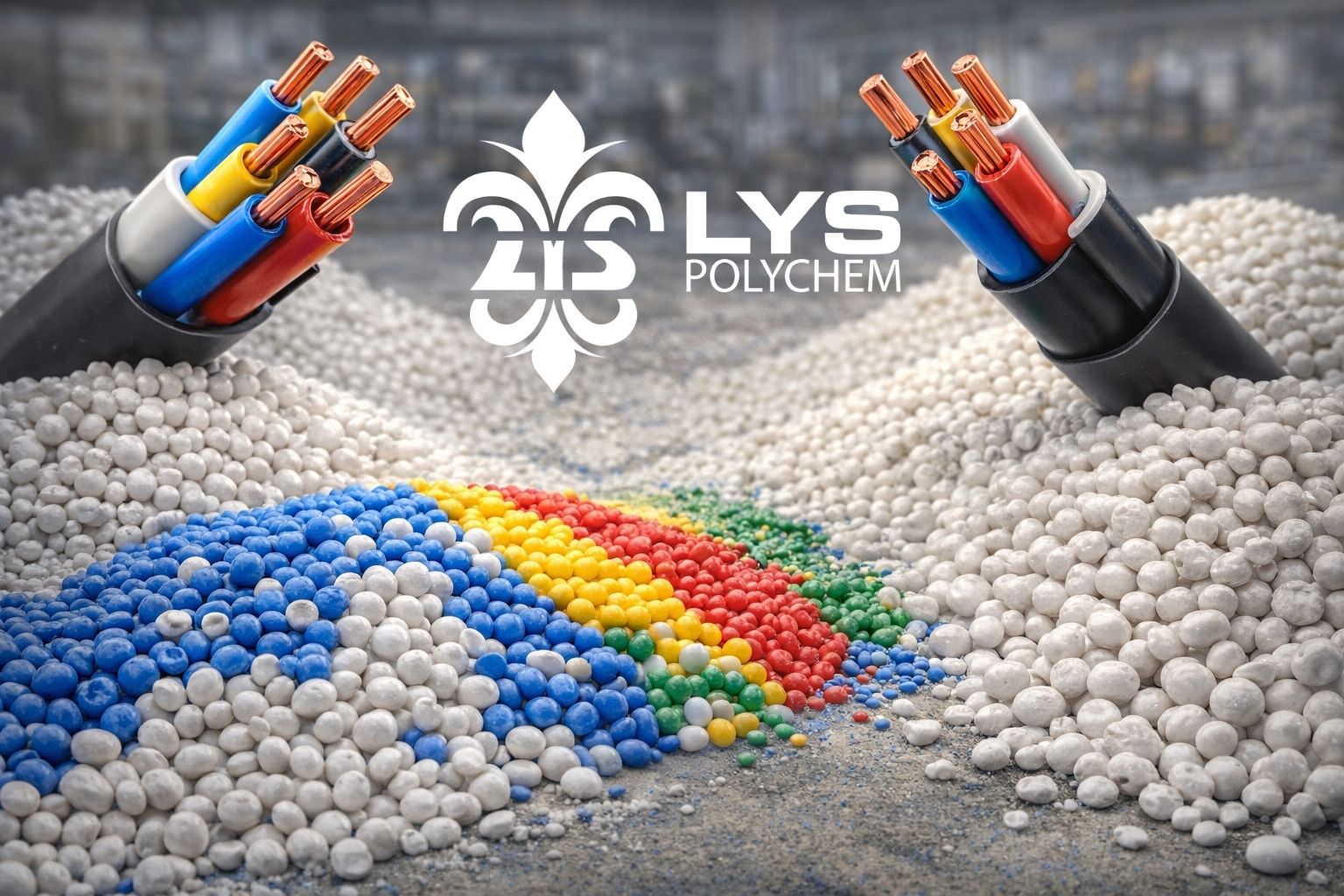
Choosing the Right Compound for Long-Lasting PVC Cables
In the cable industry, long service life is not determined by conductor quality alone. A cable’s ability to maintain its physical structure, electrical performance, and processability over the years depends directly on the PVC compound used in its production. Today, there are many different PVC compound solutions available on the market. However, not every compound is suitable for cable applications where long service life is expected.
This is especially important for products used in power cables, building wiring cables, control cables, and various industrial applications, where compound selection becomes a critical engineering decision. A cable may look excellent when it is first produced, but the real performance reveals itself over time. A cable that hardens, cracks, loses flexibility, or deteriorates under thermal stress creates serious risks in terms of both safety and cost.
For this reason, choosing the right PVC compound for long-lasting cables is not simply a raw material preference. It is one of the fundamental factors that affects the total life cycle of the product.
Why Is Long Service Life Important in PVC Compound Selection?
Cables often operate under demanding conditions. Temperature fluctuations, mechanical stress, moisture, high processing temperatures, and long-term use all place continuous pressure on the compound structure. If the formulation is not properly designed, performance loss can begin internally even when the cable still appears intact from the outside.
A long-lasting PVC compound should be able to maintain the following properties over time:
Mechanical strength
Flexibility
Resistance to thermal aging
Electrical insulation stability
Resistance to cracking and embrittlement
Homogeneous behavior throughout processing
The issue here is not only the quality of the cable at the time of production. What truly matters is whether it can continue to deliver the same level of reliability years later in the field.
How Should a PVC Compound Be Evaluated for Long-Lasting Cable Performance?
When selecting a PVC compound, focusing only on price is not the right approach. A low-cost but unbalanced formulation may lead to more returns, higher process losses, and more field failures in the long run.
For this reason, the following criteria should be evaluated together during compound selection:
Thermal aging performance
Tensile strength and elongation values
Hardness balance
Migration resistance
Low-temperature performance
Extrusion stability
Suitability for the final application
Not every cable type has the same requirements. The expectations for a building wiring cable are different from those for a cable used in industrial applications. That is why application-specific PVC compound selection always delivers healthier and more reliable results than a standard one-size-fits-all approach.
Reliable PVC Compound Solutions with LYS Polychem
In the cable industry, product quality is increasingly shaped by formulation expertise and processing experience. Today, the real point of difference is not simply producing compounds, but developing PVC compound structures that demonstrate long service life in the field, remain stable during processing, and meet technical performance expectations.
With the PVC compound solutions it develops by considering the performance balance required by the cable industry, LYS Polychem aims to establish a strong balance between processability, thermal resistance, mechanical performance, and long service life.
As a result, a long-lasting cable does not happen by chance. When the right resin selection, a controlled plasticizer structure, a suitable stabilizer system, and a balanced formulation come together, the result is a PVC compound structure that provides greater reliability in the field for a longer period of time.