LYS Polychem Blog
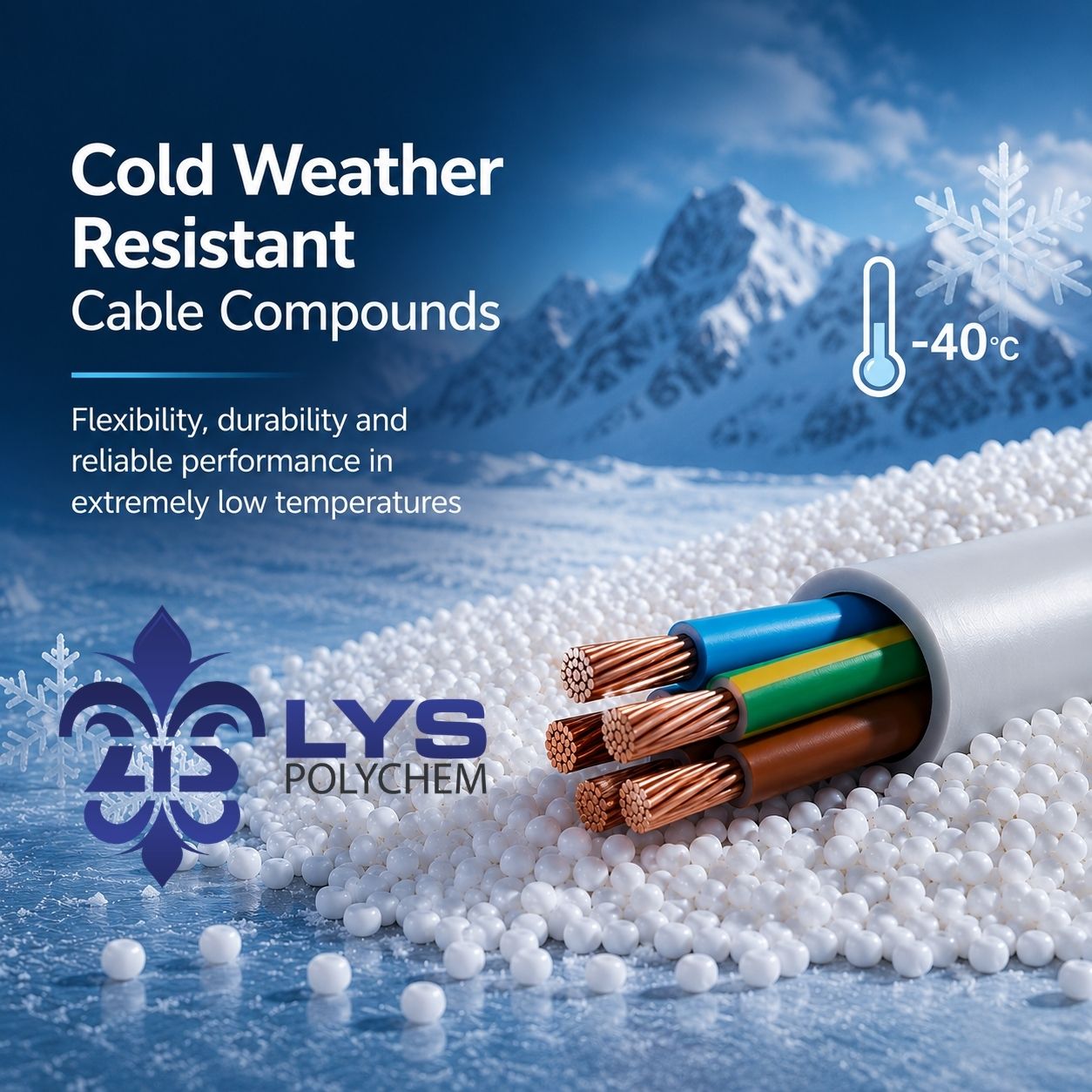
Cold-Resistant Cable Compounds: Technical Guide and Application Areas
From polar climates and high-altitude wind turbines to cold storage facilities and military field applications, cables must operate safely under extremely low temperatures in many critical environments. However, not every cable compound is suitable for these demanding conditions. Standard formulations may lose flexibility as temperatures drop; the material can become harder, more brittle, and significantly weaker in terms of mechanical performance.
For this reason, choosing the right compound for projects that require low-temperature performance is not only a raw material decision. It is a critical engineering choice that directly affects product lifetime, operational reliability, and field performance. Especially in cables used in outdoor environments, moving systems, and harsh climate conditions, compound quality plays a decisive role in the real performance of the final product.
Why Do Cables Become Brittle at Low Temperatures?
Every polymer has a specific glass transition temperature, known as Tg. When the temperature drops below this critical level, the mobility of polymer chains decreases. As a result, the material loses flexibility, becomes harder, and begins to behave in a brittle way under impact or bending stress.
In cable applications, this can create several risks:
Surface Cracks
Micro-cracks that may not be noticed at first can form on the cable outer sheath or insulation layer.
Mechanical Breakage
A material exposed to impact under low temperatures may break suddenly instead of flexing.
Reduced Bending Performance
In moving cable systems or during installation, cables that need to bend may lose their structural integrity.
Weakened Insulation Safety
Material deformation can lead to long-term electrical safety risks and field failures.
This performance loss is especially critical in outdoor energy cables, industrial plant cables, defense industry applications, and cold chain systems. It does not only reduce product lifetime; it can also increase failure risk, maintenance costs, and safety concerns.
Which Engineering Approaches Are Used in Cold-Resistant Compound Design?
Developing a low-temperature-resistant compound requires the balanced optimization of all components in the formulation. The main goal is to help the material maintain its flexibility at low temperatures and minimize the tendency to become brittle.
In cold-resistant cable compound design, the polymer base, plasticizer system, filler structure, stabilizer package, and processing characteristics must be considered together. A successful formulation should not only provide flexibility in cold conditions but also maintain mechanical strength, processability, and long-term durability.
The compound must be designed according to the expected operating temperature range, cable structure, movement requirements, installation conditions, and environmental exposure. This makes formulation design a key factor in achieving reliable cable performance under harsh climate conditions.
Where Are Cold-Resistant Cable Compounds Used?
Compound solutions with low-temperature resistance are preferred today in many critical industries. These materials are important not only because they allow cables to operate in cold environments, but also because they support longer service life and lower maintenance needs.
Arctic and Harsh Climate Energy Projects
In outdoor energy cables, the outer sheath must maintain its flexibility at very low temperatures. Otherwise, cracking and insulation loss may become inevitable. Cold-resistant cable compounds help support safer and more reliable performance in energy transmission and distribution projects exposed to extreme climate conditions.
Cold Storage Facilities and Logistics Systems
Moving cables used in forklifts, conveyors, automation systems, and cold chain equipment are exposed to continuous mechanical stress under low temperatures. In these applications, cold-bend performance and impact resistance are highly important. The right compound selection helps cables remain flexible and durable during daily operation.
Military and Defense Industry Applications
Cables used in tactical communication systems, field equipment, and mobile defense systems must offer high resistance against shock, vibration, sudden temperature changes, and harsh environmental conditions. Cold-resistant compounds help improve cable reliability in demanding defense applications where failure is not an option.
Wind Energy and High-Altitude Systems
Cables used in wind turbines and high-altitude equipment operate under both low temperatures and continuous mechanical load. Therefore, compound formulation plays a critical role in long-term durability. Low-temperature flexibility, mechanical strength, and resistance to environmental stress are essential for cable performance in wind energy systems.
Industrial Outdoor Applications
For cables used in mining, infrastructure, heavy industry, and outdoor field equipment, low-temperature flexibility is one of the key elements of field reliability. These applications often involve mechanical stress, exposure to changing weather conditions, and long service expectations. A properly designed compound helps reduce the risk of cracking, breakage, and operational interruption.
Why Does the Right Compound Selection Provide Long-Term Advantages?
A wrongly selected or low-performance compound may seem cost-effective at first. However, when cracking, breakage, downtime, and maintenance costs occur in the field, this choice may create a much higher total cost in the long term.
A correctly designed cable compound can provide the following advantages:
It helps maintain flexibility at low temperatures.
It increases impact and bending resistance.
It extends product service life.
It reduces field failures and maintenance needs.
It supports operational reliability.
It makes final product quality more sustainable.
Therefore, cable compound selection is strategically important not only for meeting technical specifications, but also for protecting the brand’s quality standards and maintaining customer satisfaction.
Reliable Cold-Resistant Compound Solutions with LYS Polychem
In cable applications that require low-temperature resistance, compound performance directly determines the success of the product in the field. LYS Polychem aims to provide manufacturers with more reliable, more durable, and more sustainable product structures by developing compound solutions suitable for different application scenarios and operating conditions.
When the application’s temperature range, movement requirements, mechanical load level, and processing needs are analyzed correctly, it becomes possible to achieve results that make a real difference in the field. At LYS Polychem, we offer high-performance answers to the technical expectations of cable manufacturers with compound solutions specially developed for harsh climate conditions.
For reliable, long-lasting cable production suitable for cold climate conditions, you can contact the LYS Polychem technical team.