LYS Polychem Blog
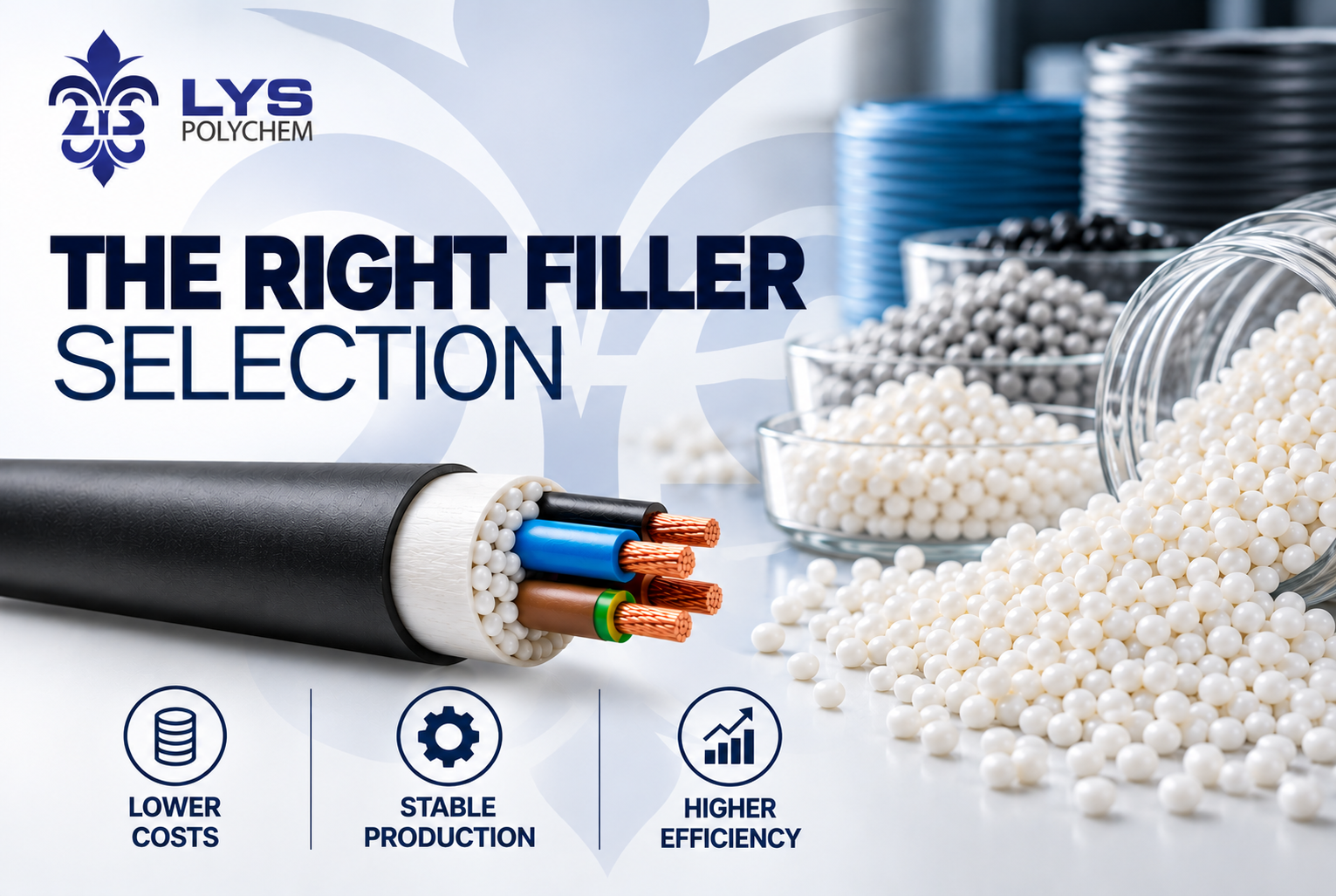
How the Right Filler Selection Helps Optimize Cable Manufacturing Costs
Raw material costs account for a significant share of total cable manufacturing expenses. Fluctuating polymer prices, energy costs, and increasing competition are prompting cable manufacturers to manage their cost structures more carefully.
In this context, the use of fillers should not be viewed simply as a way to reduce polymer consumption in cable sheathing. The right filler solution can help optimize raw material costs, support process stability, and provide greater control over final product properties.
Cost optimization in cable manufacturing is therefore not about adding more filler. It is about selecting the right filler system and using it at the appropriate loading level.
What Is a Filler in Cable Manufacturing?
Fillers are mineral-based materials used in polymer processing to support mechanical, physical, visual, or economic objectives.
In the cable industry, filler solutions can be used to balance polymer consumption and optimize manufacturing costs, depending on the application.
Filler systems are generally selected to help:
• Optimize polymer usage
• Control raw material costs
• Adjust hardness and mechanical properties
• Support dimensional stability
• Improve surface quality and processing behavior
• Achieve more consistent results in mass production
The results achieved with a filler depend on the mineral structure, particle size, particle size distribution, surface characteristics, and compatibility with the polymer system.
Why Are Fillers Important in Cable Manufacturing?
For cable manufacturers, fillers are an important tool for managing raw material costs, particularly in high-volume production.
However, a filler is more than a cost-reduction ingredient. When the right system is selected, it can also influence compound processability, mechanical behavior, and production stability.
Optimizing Polymer Consumption
Polymer raw materials are a major component of cable manufacturing costs. An application-appropriate filler can help reduce polymer consumption to a certain extent.
This can provide a meaningful unit-cost advantage, especially in high-volume production.
However, simply increasing filler loading is not an effective strategy. Excessive or incompatible filler content can compromise final product performance and lead to production losses.
Improving Raw Material Cost Control
When polymer prices fluctuate, filler systems can help reduce sensitivity to resin costs.
To turn this potential benefit into genuine cost optimization, the following factors should be assessed together:
• Filler loading level
• Compatibility with the polymer
• Processing behavior on the production line
• Mechanical properties of the finished product
• Scrap rate
• Line speed
• Energy consumption
• Customer and application requirements
Lowering the cost per kilogram with a filler solution is not enough on its own. Its impact on total manufacturing costs must also be considered.
Influencing Hardness and Mechanical Performance
Filler loading and the properties of the selected mineral can affect compound characteristics such as hardness, flexibility, elongation at break, and impact resistance.
Cable manufacturers must therefore consider not only cost targets but also the mechanical requirements of the final application.
How to Choose the Right Filler for Cable Manufacturing
1. Compatibility With the Base Polymer
Compatibility between the filler solution and the polymer system is essential for uniform dispersion and stable production.
An incompatible system can cause:
• Poor dispersion
• Surface defects
• Reduced mechanical performance
• Irregular flow during extrusion
• Agglomeration within the compound
The compatibility of the filler solution with PVC, PE, or other relevant polymer systems should therefore be evaluated.
2. Particle Size and Distribution
The particle size and particle size distribution of a filler can affect surface quality and processing behavior.
An irregular or application-inappropriate particle structure may lead to:
• Surface roughness
• Defects at the die exit
• Reduced mechanical performance
• Equipment wear
• Printing and marking problems
3. Filler Loading Level
Higher filler loading may create raw material cost advantages. However, the loading level should not be increased without considering the requirements of the final product.
The following criteria should be assessed when determining an appropriate filler loading level:
• Cable type
• Insulation or outer sheath application
• Target hardness
• Flexibility requirements
• Mechanical strength
• Surface quality
• Extrusion line specifications
• Customer technical specifications
4. Dispersion Quality
Uniform dispersion of the filler throughout the compound is critical to both production stability and product quality.
Non-uniform dispersion can cause variations in mechanical properties, surface defects, and inconsistent quality in mass production.
5. Moisture and Storage Conditions
Moisture exposure in filler systems can lead to surface defects and processing issues during extrusion.
Storage, packaging, and handling conditions should therefore be managed in line with the manufacturer’s recommendations.
Why Cost per Kilogram Alone Is Not Enough
Cost analysis in cable manufacturing should not be based solely on the purchase price of raw materials.
A lower-priced filler solution may increase total manufacturing costs if it results in:
• Reduced line speed
• Higher scrap rates
• Surface defects during extrusion
• Frequent die cleaning
• Production downtime
• Failed mechanical tests
• Customer returns
• The need for rework or repeat production
The better approach is to assess total manufacturing costs rather than focusing only on cost per kilogram.
What Information Should Cable Manufacturers Provide When Requesting a Filler Solution?
To identify a suitable filler solution, cable manufacturers should clearly communicate their application and processing requirements.
A filler inquiry may include:
• Type of cable being manufactured
• Insulation or outer sheath application
• Base polymer in use
• End-use application
• Target filler loading level
• Hardness and flexibility requirements
• Mechanical performance requirements
• Surface quality expectations
• Extrusion line specifications
• Target line speed
• Current processing challenges
• Sample or full-scale production quantity
This information supports faster evaluation of suitable filler alternatives and more efficient planning of sample evaluations.
LYS Polychem Filler Solutions for the Cable Industry
LYS Polychem develops and manufactures compounds and filler solutions for different application requirements across the cable, footwear, and plastics industries.
When evaluating filler solutions for cable manufacturing, the technical requirements of the application, polymer system, and production line characteristics can be considered together.
The following criteria can guide solution selection:
• Cable and application type
• Base polymer
• Target filler loading level
• Mechanical properties
• Hardness and flexibility requirements
• Surface quality
• Process stability
• Line speed
• Cost optimization objective
This approach helps cable manufacturers manage not only raw material expenses but also total manufacturing costs more effectively.
Contact LYS Polychem to Discuss the Right Filler Solution for Your Cable Production
Every cable application has different cost, processing, and technical performance requirements.
Contact LYS Polychem to discuss filler options suited to your cable manufacturing process and explore alternatives that may support cost optimization.
SEO PUBLISHING FIELDS
Editorial reference only — do not paste this page into the article body.
SEO title
Cable Filler Selection and Manufacturing Costs | LYS Polychem
Meta description
Learn how the right cable filler selection can help control raw material costs, support extrusion stability, and maintain cable compound performance.
Suggested URL slug
cable-filler-selection-manufacturing-costs
Primary target phrase
cable filler selection
Supporting search phrases
cable manufacturing costs; mineral fillers for cable compounds; filler loading in cable compounds; cable extrusion stability; cable compound cost optimization
Page heading structure
1 × H1 for the article title; H2 for main topics; H3 for supporting sections and the five selection criteria
Internal linking recommendation
Add links to relevant existing LYS Polychem cable compound/filler pages and the contact page, where available.
Optional image alt text
Mineral fillers and polymer compounds used in cable manufacturing — only if this accurately describes the chosen image.
Editorial note
Keyword phrases are editorial recommendations; search volumes and rankings have not been validated. The article’s technical statements follow the source document.